
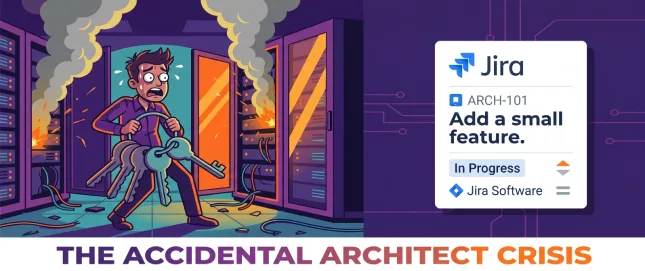
The Silent Problem
There is a specific moment in every developer’s career that feels like a quiet rite of passage. It usually hits around 2:00 PM on a Tuesday. You’re staring at what looks like a straightforward feature request, but the choice you’re about to make isn’t just a coding task; it’s an architectural decision with long-term consequences. Welcome to the Accidental Architect crisis.
We’re All Making Architectural Decisions — Whether We Realize It or Not
The tech industry has a major misconception: that “Architecture” is something that only happens in glass offices by people with 20 years of experience and fancy titles like “Principal Software Architect.”
This belief is not only wrong; it’s dangerous.
If you are writing code that other people will maintain, integrate with, or scale in production, you are already making architectural decisions. Every choice about data flow, service boundaries, error handling, or state management shapes the long-term health of the system.
Most developers never receive the framework, mental models, or vocabulary to do this intentionally. Instead, they stay in “make it work” mode, accidentally building systems that become expensive legacy disasters as the company grows.
The Hidden Senior Engineer Ceiling
In today’s tech landscape, developers with just 3–5 years of experience are regularly promoted to Senior Engineer. On paper, this looks like rapid career growth. In practice, many feel more lost than they did as juniors.
Why? Because the industry has equated seniority with speed of syntax: how fast you can spin up a microservice, debug a React hook, or ship a feature.
But there’s a hidden ceiling that raw coding speed cannot break through.
The real transition happens when you realize that every line of code is a long-term liability. This realization marks the birth of an architect. Yet most companies provide little to no formal architectural training, forcing developers to make critical structural decisions in isolation.
A Modern Cautionary Tale: The Distributed Monolith Trap
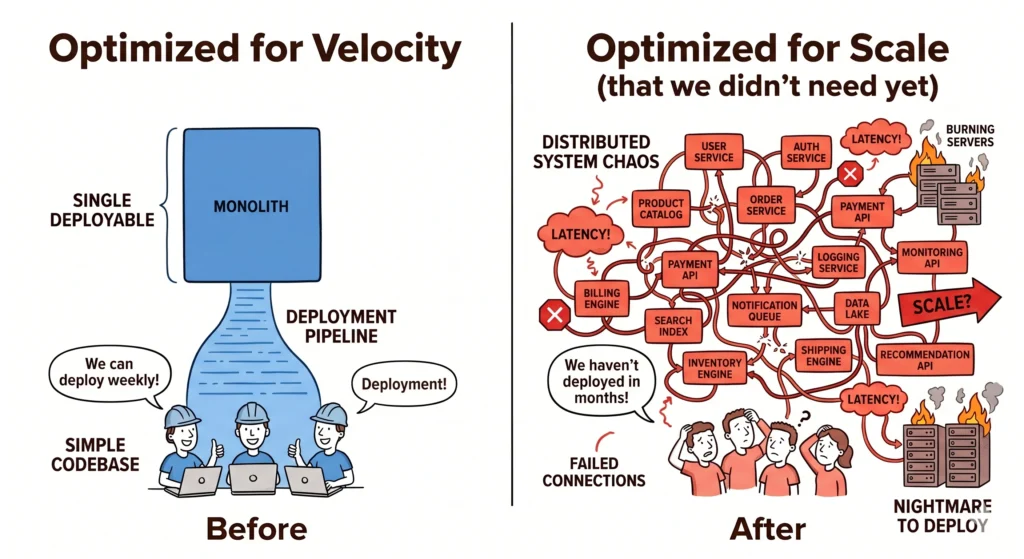
A few years ago, I watched a team of talented but accidental architects make a fateful decision. They read that microservices were the “best practice” for scaling and decided to break their entire backend into 15+ services.
They optimized for scale before they actually needed it.
Six months later, they hadn’t shipped any meaningful new features. Instead, they were drowning in operational complexity: network latency issues, distributed tracing nightmares, data synchronization problems, and deployment headaches.
They had chosen the wrong pain. They optimized for a future problem while ignoring their current business constraint: velocity.
Why AI Is Accelerating the Accidental Architect Crisis
The situation is becoming even more dangerous with the rise of Generative AI.
Tools like GitHub Copilot, Claude, and ChatGPT excel at the “How.” They can generate boilerplate, APIs, and entire features at incredible speed. Implementation has become a commodity.
This means the Accidental Architect is now armed with a flamethrower. They can generate a huge amount of architectural complexity at 10x the speed of a human.
If you ask an AI, “How should I build a scalable e-commerce site?” it won’t ask about your team size, your budget, or your constraints. It may confidently spit out a highly complex, enterprise-grade blueprint featuring Kubernetes, Kafka, Redis, and 15 microservices, complete with the Terraform scripts to build it.
But the AI doesn’t actually understand holistic system context. It is just a probabilistic engine stitching together statistically likely buzzwords from enterprise engineering blogs and random code samples it finds online of varying quality. The result is often a Frankenstein’s monster of an architecture: pieces that look great in isolation but are structurally at odds with each other and collapse when forced to work together as a living system.
If you blindly copy and paste that AI-generated infrastructure into production without applying any standard of architectural thinking, you aren’t just an Accidental Architect anymore. You are an Accidental Arsonist.
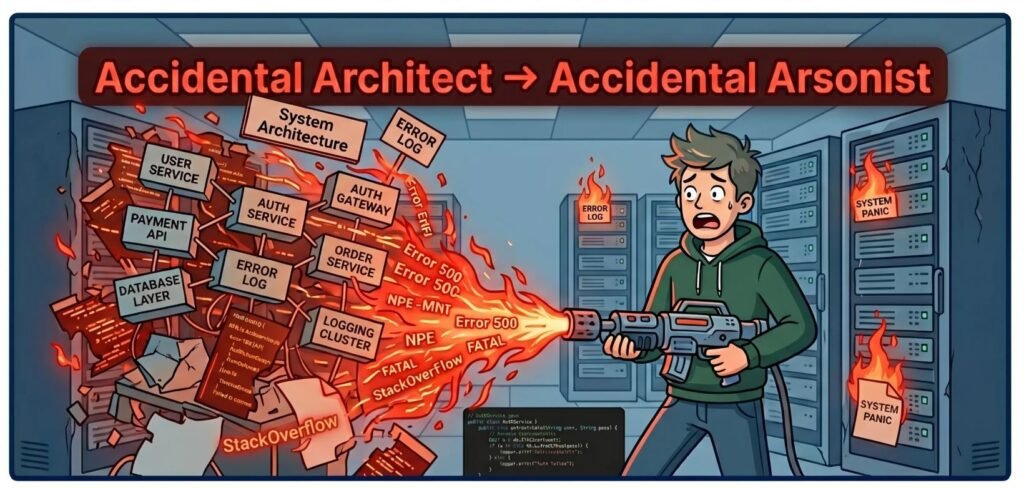
Why? While human-written technical debt slowly rots a system over years like termites, AI-generated architecture can burn it down overnight. By letting an algorithm make your tradeoffs for you, you could instantly incinerate your company’s monthly AWS budget on unnecessary servers. You might open gaping security holes by deploying random third-party libraries and misconfigured IAM roles. You are burning down your team’s agility by locking them into a distributed system they don’t know how to debug and many times even what architectural design it is following.
The Journey From Syntax Coder to Clarity Engineer
So how do you break out of this trap?
It requires a fundamental change in how you approach your work. You must move from being a Syntax Coder to becoming a Clarity Engineer.
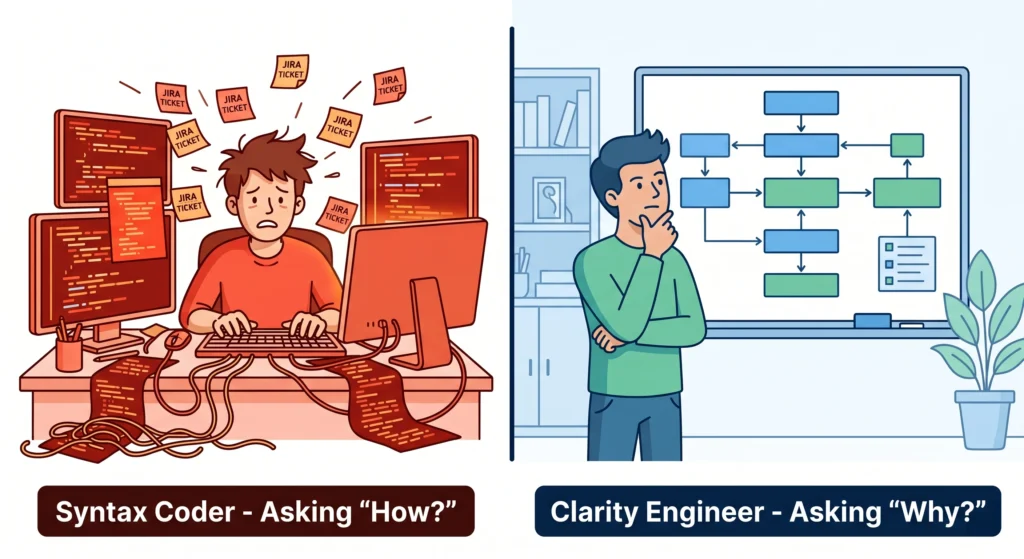
- A Syntax Coder sees a Jira ticket and asks: “How do I make this work?”
- A Clarity Engineer sees the same ticket and asks: “What is the real business intent behind this request, and how do I design a system that protects that intent for the long term?”
Clarity Engineering is about asking “Why?” before “How?”. It’s about interrogation and making defensible decisions instead of following tutorials or hype.
Picking Your Pain on Purpose
Here’s the hard truth every architect eventually accepts: There is no perfect architecture.
Every decision is simply choosing which set of problems you’re willing to live with. Junior developers argue about which tool is “better.” Real architects make defensible decisions: they weigh the tradeoffs, document their reasoning, and prepare for when things change.
Conclusion: Claim Your Toolkit
The Accidental Architect Crisis is real, but it doesn’t have to be your career’s end. You don’t have to wait for a promotion to start making deliberate, high-impact choices. You are already building the future of your company. You just haven’t been given the blueprints yet.
The industry is shifting. Speed is becoming a commodity, but Clarity is becoming the most valuable asset an engineer can own. Don’t be an architect by accident. Be one by design.
Stop building by accident. Start designing with clarity. I’m Matt Erman, better known online as CodeLiftSleep, and I’m helping developers move from “writing code that compiles” to “designing systems that survive.”

That’s why I wrote Grokking Software Architecture (Manning Publications).
This book is a practical, engaging, fun, analogy-rich, illustration-heavy guide designed to give you the foundational mindset, tools, and confidence to make better architectural decisions immediately. No dense academic theory; just real-world principles you can apply starting on DAY ONE.
The book is currently in MEAP (Early Access). You can start reading chapters as they’re released and give direct feedback, helping to make the book even better.
Grab your copy at 🔥 50% OFF today during Manning’s Sitewide Sale through May 14th: https://hubs.la/Q04dH6hC0
Want more foundational advice for your early career? Check out my earlier post: 7 Essential Tips for a Junior Developer’s First Year, packed with practical advice to help you thrive from day one.
Stop building systems by accident. Start designing with clarity.
Leave a Reply